
Specimen Collection and Transport in the Physician Office Laboratory
April 11, 2024
Learning Objective: Examine the procedures for specimen collection and transport in the physician office laboratory.
Specimen collection and handling are important considerations in patient care because the results are only as good as the quality of the sample. Ideally, specimens should be collected during the acute phase of an illness and before antibiotics are prescribed. Specimens for microbiology testing can include urine, stool, sputum, and blood. Sterile swabs can be used to collect samples from wounds and the upper respiratory tract.
Guidelines for Specimen Collection
Learning Objective: Explain the guidelines for specimen collection.
Specimens must be collected carefully so that contaminating microorganisms are not introduced into the specimen. This means not only using sterile collection and transport devices but also taking steps to prevent contamination. To prevent from contaminating the specimen, the person should do the following:
• Wash hands before collecting the sample.
• Cleanse the area involved with an antiseptic, if appropriate. For example, when obtaining a clean-catch midstream urine specimen, antiseptic wipes are used.
• Open sterile containers only when necessary and avoid touching the inside surfaces.
• Never touch a sterile swab or collection device on a nonsterile surface.
If patients are expected to collect a sample, it is crucial that they receive clear instructions on how to perform the procedure correctly and without contaminating the sample. The referral laboratory is responsible for providing a manual of written instructions to the POL. The POL is responsible for providing clear oral and written instructions to the patient. If the patient will be collecting the sample in private or at home, written instructions that are simple and straightforward should be supplied.
To protect from pathogen exposure, the medical assistant should wear the appropriate personal protective equipment (PPE) when collecting, handling, and processing specimens. The medical assistant should wear gloves, a fluid-impermeable lab coat, a surgical mask (for droplet or airborne pathogens), and protective eyewear or a face shield. Proper handwashing techniques are also important before and after the procedure.
The following sections discuss transporting specimens and how to collect different types of specimens.
Guidelines for Handling and Transporting Specimens
Learning Objective: Explain the guidelines for handling and transporting specimens.
The transport of specimens to referral laboratories is also crucial. Different types of transport devices are available. Close attention must be given to their proper use. Microorganisms are living organisms, so they must be given conditions that ensure their survival. Care must also be taken so that any normal flora in the sample will not multiply and overgrow possible pathogens. The type and number of microorganisms in the sample should reflect the type and number of microorganisms at the site of collection and at the time of collection.
Specialized transport media are often included with specimen collection swabs or devices (FIGURE 35.5). Collection devices typically consist of a plastic tube that encases a sterile Dacron swab and a sealed vial of transport medium. After the specimen has been collected on the swab, it is placed in the plastic tube with the transport medium. It is essential to follow the manufacturer’s directions to prevent the swab and specimen from drying out. Transport system swabs also have a label that must be filled out completely, indicating the patient’s full name, the date and time of collection, the collector’s initials, and the source of the specimen (e.g., deep wound sample from left leg abscess).
If possible, a specimen should be placed on culture media immediately after collection. If this is not possible, then the transport device must be sent to a referral laboratory or held in the POL until it can be cultured. For specimens that will be transported by a courier, make sure the specimen is safely packaged in a leak-proof container marked with warning labels (FIGURE 35.6). The proper time and temperature of storage are vital. Most pathogenic organisms prefer body temperatures, of approximately 37°C (98.6°F). They will remain viable for up to 72 hours if held at room temperature or refrigerator temperature (4°C [39.2°F]). Some organisms die if exposed to cold temperatures. Always check the referral laboratory’s procedure manual for directions regarding sample time and temperature of storage.
See FIGURE 35.7 for some commonly used microbiology collection devices. Devices used for both aerobic and anaerobic blood collection are shown in FIGURE 35.7A, and BACTEC blood culture bottles are pictured in FIGURE 35.7B. Two other commonly used transportation devices are the JEMBEC plate for transporting Neisseria gonorrhoeae (see FIGURE 35.7C) and a viral-chlamydial transport medium (see FIGURE 35.7D).
See TABLE 35.3 for a description of the specimens, containers, patient preparation processes, and storage of specimens commonly collected or handled by medical assistants.

FIGURE 35.5 Collection and transport system for patient samples.

FIGURE 35.6 Microbiology specimen containers.
35.4 Critical Thinking Application
Each time Laura collects a wound swab that needs to be sent to the reference laboratory, she needs to put the swab in a transport medium. List three reasons why we use transport media when wound specimens cannot be tested immediately. Be ready to share your ideas with the class.
Stool Specimen Collection
Learning Objective: Explain the collection process and examination of a stool specimen.
Stool specimens are commonly examined for parasitic protozoa and helminths. The specimen is collected and placed into two vials, each with a preservative. From these preparations, a wet mount slide is made to observe moving organisms. A stained smear is made from a concentrated specimen. The smear is looked at under a microscope to observe protozoal cysts and helminth eggs. The medical assistant should always consult the procedure manual provided by the referral laboratory when an ova and parasites stool examination (O&P) is ordered to make sure that proper specimen collection and transport takes place (Procedure 35.1).

FIGURE 35.7 (A) Blood collection Vacutainer tubes, one for aerobic and one for anaerobic. (B) Bactec blood culture bottles. (C) Jembec plate. (D) Viral-chlamydial transport medium. From De la Maza LM, Pezzlo MT, Baron EJ: Color atlas of diagnostic microbiology, St. Louis, 1997, Mosby.
Collection, Transport, and Processing of Specimens Commonly Collected in the Physician Office Laboratory a

O&P, Ova and parasites; PVA, polyvinyl alcohol; SPS, Sodium polyanethole sulfonate.
a Reference laboratories also have specific directions for collecting specimens based on their testing methods.
Modified from Forbes BA, Sahm DF, Weissfeld AS: Bailey and Scott’s diagnostic microbiology, ed 11, St. Louis, 2002, Mosb
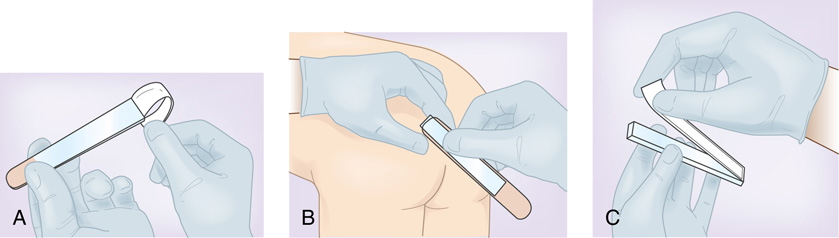
FIGURE 35.8 The three steps for collecting a pinworm specimen from a child. (A) Place cellulose tape over a tongue depressor with the sticky side out. (B) Press the tape firmly against the right and left anal folds. (C) Place the tape with adhesive side down onto the microscope slide.
Pinworm Collection
Learning Objective: Explain how collection for pinworm testing is done and when it is recommended.
Enterobius vermicularis is commonly known as pinworm. The eggs hatch in the small intestine, and the females migrate out of the anus, usually at night, to deposit the eggs. The eggs adhere to the skin and hair surrounding the anus, sleeping garments, and other clothing. Pinworms cause itching in the anal area, which may cause the eggs to come in contact with the hands and fingernails of the host.
Pinworm infection is spread by the fecal-oral route. The infective pinworm eggs are transferred to the mouth directly by the hand or indirectly through contaminated clothing, food, liquids, and other articles. Since the pinworm eggs are so small, they can sometimes become airborne and are ingested while breathing.
In children, specimens are best collected late at night or early in the morning. Paraffin swabs impregnated with petroleum jelly or cellulose tape may be used to collect the eggs deposited by the adult worm during the night. The diagnosis is based on laboratory detection of the eggs in fecal smears. Some parents do not feel comfortable collecting the specimen. The medical assistant should instruct those parents to bring children to the office as soon as they wake up in the morning. Instruct the parents not to change the child’s clothing or diaper before coming into the office. When the child arrives, have all the needed supplies ready to use, and perform the procedure immediately (FIGURE 35.8).
Nasal and Nasopharyngeal
Specimen Collection
Learning Objective: Explain the types of nasal and nasopharyngeal specimens that may be collected.
Nasal and nasopharyngeal specimens are obtained for several respiratory tests, including COVID-19. Depending on the state’s medical assistant scope of practice, a medical assistant may be able to perform nasal and nasopharyngeal specimen collection (Procedure 35.2). The types of swabs used depend on the test and the collection site.
Three types of specimens can be collected:
• Anterior nasal specimen: The swab is inserted no more than 0.5 of an inch (1 cm) into the nostril (FIGURE 35.9).
• Mid-turbinate nasal specimen: With the patient’s head tilted back at a 70-degree angle, the swab is inserted parallel to the nostril floor until resistance is met at the nasal turbinates. The swab is usually inserted no more than 1 inch (2 cm). This specimen is taken deeper into the nose than the anterior nasal specimen.
• Nasopharyngeal (NP) specimen: When obtaining the specimen, the patient’s head should be tilted back at a 70-degree angle. The minitip swab needs to be inserted through the nostril. Insert the swab so it is parallel to the palate, and continue to carefully insert it until resistance is encountered. The swab needs to be inserted the same distance as the nostril to the outer opening of the ear.

FIGURE 35.9 Obtaining an anterior nasal specimen.
The swab should be gently rolled and then left in place for several seconds to allow it to absorb secretions. A specimen is obtained from both nostrils unless the swab is saturated with secretions from the first nostril. If the patient has a nasal blockage or deviated septum, the unobstructed nostril should be used for the collection.
Sputum Specimen Collection
Learning Objective: Explain how a sputum specimen is collected.
Sputum cultures may be ordered when patients have symptoms that may be related to infectious respiratory diseases. The following are examples of other sputum tests:
• Legionella testing for legionnaires’ disease
• Acid-fast bacillus (AFB) testing for tuberculosis
• Gram stain for bacterial or fungal infections
The medical assistant may be responsible for coaching patients on how to collect sputum specimens. Many times, sputum specimens are collected in the morning. For some tests, three sputum samples may be collected over 3 days. When collecting a sputum specimen, patients should do the following:
1. Avoid food for 1 to 2 hours before collecting the sputum specimen.
2. Rinse your mouth well to remove food particles.
3. Open the container and avoid touching the inside of the container and cover.
4. Inhale two to three times, breathing out hard each time, then cough deeply.
5. Collect the sputum from the cough. Do not spit oral secretions into the cup.
6. Cover the container when enough sputum is collected.
The medical assistant should discuss how the specimen should be stored and brought to the healthcare facility for testing.
Throat Swab Specimen Collection
Learning Objective: Explain how a throat swab specimen is collected.
A throat swab specimen collection is a common procedure in the ambulatory care facility. This type of specimen is used to identify the cause of throat infections, such as strep throat. It is important that patients resist gagging and closing their mouths while the swabbing occurs. Procedure 35.3 describes the collection process. Patients should not use antiseptic mouthwash before the collection.
Wound Swab Specimen Collection
Learning Objective: Explain how a wound swab specimen is collected.
To perform a wound culture, the medical assistant will need the following items:
• A provider’s order
• A culture swab with the patient’s label, specimen bag for transport, and the laboratory requisition form
• Supplies to clean the wound (such as betadine)
• Dressing and bandages
The provider may have the medical assistant rinse the wound with normal saline to remove contaminated material (e.g., necrotic tissue and dried exudate). If the wound is dry, the swab should be moistened with sterile normal saline (NS). This helps with the collection process. If the wound is moist, no saline is needed.
To collect the specimen, the medical assistant should gently roll the swab stick from margin to margin using a zig-zag motion, using enough pressure to accumulate fluid on the swab. If pus is seen, it should be swabbed. The swab should only touch the wound. After the collection, the swab should be placed in a labeled tube. If the tube has formalin, squeeze the tube to release the formalin to preserve the specimen before sending it to the laboratory.