Lesson 1, Topic 1
In Progress

Anatomy of the Muscular System

April 11, 2024

Anatomy of the Muscular System

Learning Objective: Examine the anatomy of the muscular system.

Muscles attach to bones and are found in internal organs and blood vessels. They create movement throughout the body. Not only do muscles help create movement of the arms and legs, but they also assist with many internal processes, including breathing, digestion, and the circulation of blood.

Types of Muscles

Learning Objective: Describe the three types of muscle tissue.

Muscle tissue is composed of muscle cells (also called muscle fibers or myocytes). There are three types of muscle tissue in the body: skeletal, smooth, and cardiac. Each type has unique functions.

Skeletal Muscles

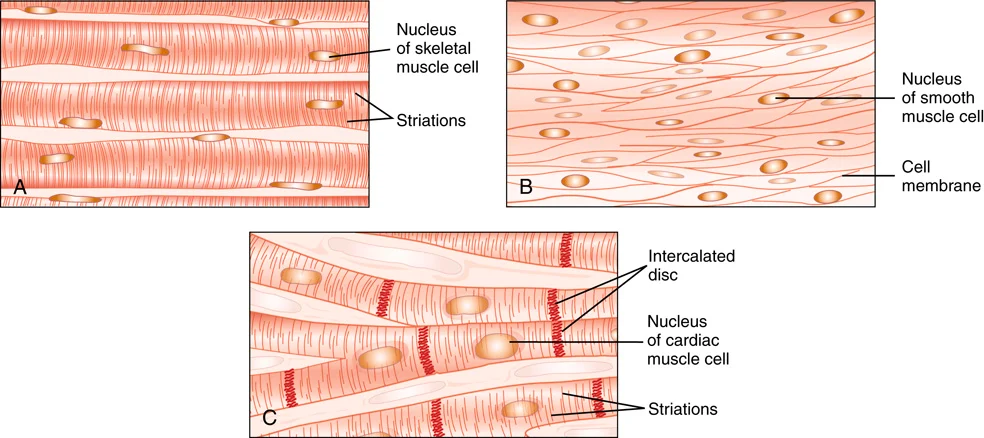
Skeletal muscles have multiple nuclei and striations that give them a striped appearance (FIGURE 20.4A). Special fibers allow them to shorten (contract) and lengthen (relax), which creates movement. Skeletal muscles are voluntary, meaning we have control of them. They are found as follows:

• Attached to the bones of the skeleton by tendons. This allows for movement of the bones at the joints and enables the body to maintain posture.
• In the upper section of the esophagus to help with swallowing.
• In the eye to allow for eye movements.
• In the urinary and digestive systems. Sphincter muscles allow for the voluntary passage of urine and stool.

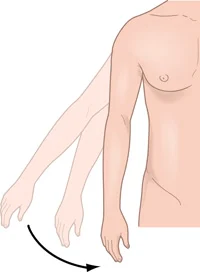
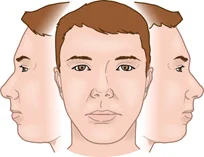
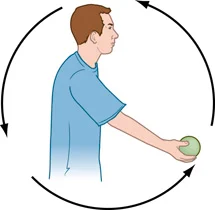
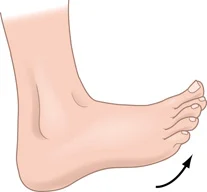
TABLE 20.1

Types of Body Movement

Movement Definition or Example
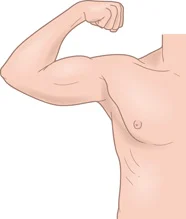
Flexion
Reduces the angle of the joint and brings the two bones closer together
Extension
The opposite of flexion; increases the angle or distance between two bones or parts of the body
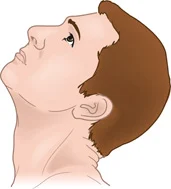
Hyperextension
Extension 180 degrees (e.g., the neck is extended backward or the toes are pointed downward)
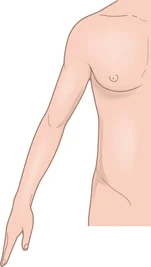
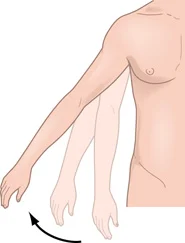
Abduction
Moving the body part away from the midline or median plane of the body
Adduction
The opposite of abduction; moving the body part toward the midline of the body
Rotation
Moving a bone around its central axis; common in ball-and-socket joints
Circumduction
Circular movement of a limb; a combination of abduction, adduction, extension, and flexion
Dorsiflexion
Moving the instep of the foot up and dorsally, reducing the angle between the foot and the leg
Table Continued
MovementDefinition or Example
Plantar flexion
A toe-down movement of the foot at the ankle; increases the angle of the joint
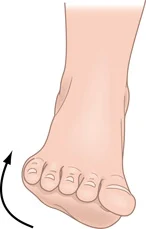
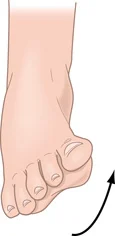
Eversion
Turning the sole of the foot laterally, or outward
Inversion
The opposite of eversion; turning the sole of the foot medially, or inward
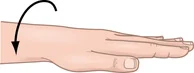
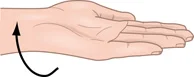
Pronation
Rotation of the forearm that turns the palm of the hand downward, or posteriorly
Supination
The opposite of pronation; rotation of the forearm that turns the palm of the hand upward, or anteriorly

FIGURE 20.4  (A) Skeletal muscle. (B) Smooth muscle. (C) Cardiac muscle. From Applegate E: The anatomy and physiology learning system, ed 4, St. Louis, 2011, Saunders.

Smooth Muscles

Smooth muscles are nonstriated and have a single nucleus (FIGURE 20.4B). They are involuntary muscles, which means we cannot control smooth muscles. Smooth muscles contract in response to hormones or neurotransmitters (e.g., acetylcholine and norepinephrine).

Smooth muscles are found in the following locations:

• The hollow organ walls of the urinary, reproductive, and digestive systems. Smooth muscles in the urinary bladder, uterus, stomach, and intestines help with movement. These visceral smooth muscles can simulate each other to contract, creating a wavelike motion called peristalsis. This motion helps substances through tubelike organs. Peristalsis can be seen in the esophagus, intestines, and fallopian tubes.
• The respiratory system organ walls, where they regulate the airflow into the lungs.
• The walls of the blood vessels and large lymphatic vessels. The smooth muscles change the diameter of the vessels, helping the blood and lymph to circulate.
• The eyes, where they change the size of the iris and shape of the lens.
• The skin, where they cause the hair to stand erect (goose pimples).

Cardiac Muscles

Cardiac muscles are involuntary, striated muscles found in the walls of the heart (FIGURE 20.4C). Cardiac muscles can shorten and lengthen their fibers for contraction. Cardiac muscle fibers are electrically linked, forming one unit. A myocardial cell forms a strong, electrical connection to the next cells through special junctions called intercalated discs. The intercalated discs are responsible for the cell-to-cell communication that is required for coordinated muscle contraction and relaxation of the heart. The intercalated discs help the muscle fibers form one unit that contracts and relaxes all at once instead of a little at a time. The “one unit” approach is important because the atrial chambers need to contract together, and then the ventricles also need to contract at the same time.

20.3

Critical Thinking Application

Marissa and Suzanne had a busy morning working with Dr. Kahn. Many of their morning patients had musculoskeletal symptoms. On break, Marissa decides to review the muscular system in her textbook in preparation for her national exam. She reviews the three types of muscles. Describe the three types of muscles.

Structure of Skeletal Muscles

Learning Objective: Describe the structure of skeletal muscles.

An entire skeletal muscle is considered an organ. Each skeletal muscle consists of nerve tissue, blood vessels, muscle tissue, and connective tissue. Skeletal muscle fibers can be very long. Besides having several nuclei, skeletal muscle cells contain other unique cellular structures:

• Sarcolemma, the cell membrane.
• Sarcoplasm, the cytoplasm in the cell.
• Sarcoplasmic reticulum (SR), the specialized smooth endoplasmic reticulum. Sarcoplasmic reticulum stores, releases, and retrieves calcium ions.
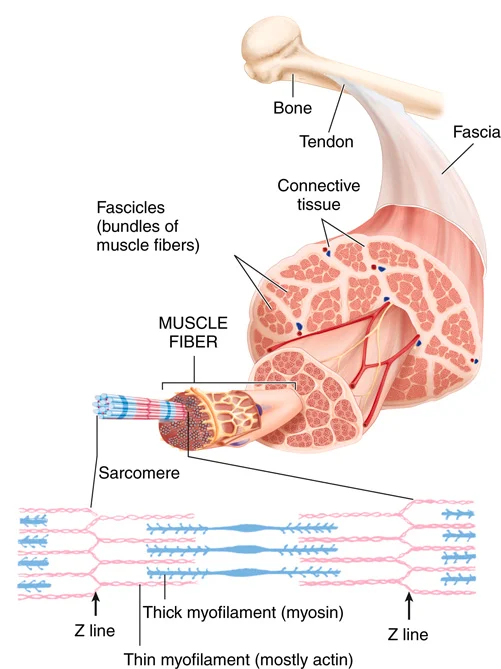
• Myofibrils, which are proteins that run the length of the cell. Myofibrils are made up of connecting sarcomeres, the basic functioning unit of a muscle. The sarcomere contains myosin, a thick myofilament, and actin, a thin myofilament, which create the striated appearance (FIGURE 20.5).

A tough fibrous connective tissue called fascia covers the muscle. The muscle also contains three layers of connective tissues (see FIGURE 20.5):

• The endomysium is a thin inner layer of connective tissue that wraps around individual muscle fibers or cells. The endomysium contains extracellular fluid and nutrients to help maintain muscle fiber.
• The perimysium is the middle layer of connective tissue. Individual muscle fibers are bundled together into fascicles. Each fascicle is covered with perimysium. Separate fascicles can be triggered for specific movements; thus, the entire muscle organ does not need to respond.
• The epimysium, a dense irregular connective tissue, is the outer layer. All of the fascicles are bundled together and covered with epimysium. The epimysium allows the muscle to maintain its structure during contraction yet move independently in the body.

FIGURE 20.5  Structure of skeletal muscle. Each muscle organ has many muscle fibers, each containing many bundles of thick and thin myofilaments. The diagrams show the overlapping thick and thin filaments arranged to form adjacent segments called sarcomeres. From Patton KT, Thibodeau GA: The human body in health and disease, ed 7, St. Louis, 2018, Elsevier

• The three layers of connective tissue extend beyond the muscle and mesh with either an aponeurosis or a tendon. Bursae (small sacs filled with synovial fluid) lie under the tendons or between some tendons and bones. The bursa helps the tendon move over the bone as the muscle contracts. Some tendons are enclosed in tendon sheaths, which are lubricated with synovial fluid.

20.4

Critical Thinking Application

Marissa needs a refresher on the skeletal muscle structure. The muscle contains three layers of connective tissue. Describe each of these layers.

Skeletal Muscle Movement

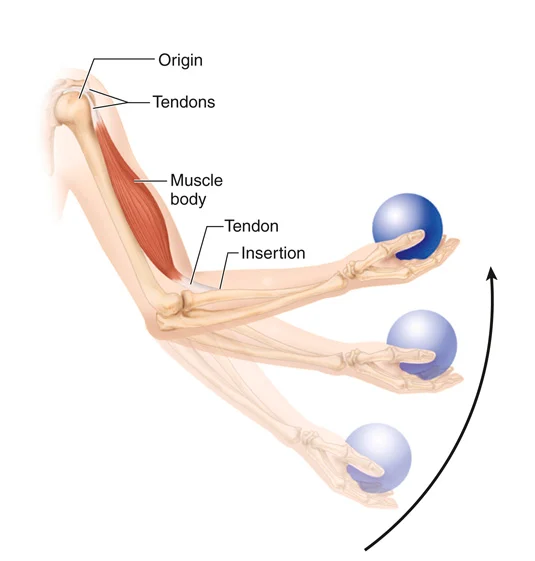
Most skeletal muscles attach to two bones and stretch across a joint. During a movement, one of the bones is considered to be stationary since it does not move. The other bone is the movable bone. The muscle’s attachment to the stationary bone is called its origin, and the attachment to the movable bone is called its insertion. The body of the muscle sits between the origin and insertion (FIGURE 20.6).
Many skeletal muscles work in pairs or groups, using antagonistic muscle movement for smooth movements. This means muscles contract while other muscles relax. The prime mover (or agonist) is the muscle responsible for the majority of the movement. The muscles that help the prime mover are called synergists. The synergists contract at the same time as the prime mover and stabilize the joint. This allows the prime mover muscle to work smoothly. The antagonist is the muscle that produces the opposite movement, relaxation. When the antagonist muscle contracts, the prime mover and its synergists produce an opposite movement.

FIGURE 20.6  Attachments of a skeletal muscle.A muscle originates at a relatively stable part of the skeleton (origin) and inserts at the skeletal part that is moved when the muscle contracts (insertion). From Patton KT, Thibodeau GA: The human body in health and disease, ed 7, St. Louis, 2018, Elsevier.

Names of Skeletal Muscles

The names of skeletal muscles are often based on the characteristics of the muscle. Some of the characteristics include size, shape, direction of muscle fibers, number of origins, location, action, and the points of the origin and insertion.
The muscles of the head and neck include (FIGURE 20.7) the following:

• Frontal: Raises the eyebrows
• Orbicularis oculi: Closes the eyes
• Orbicularis oris: Draws the lips together
• Zygomaticus: Elevates the corners of the mouth and lips
• Buccinator: Flattens the cheeks, used for whistling and blowing, aids in chewing
• Temporal and masseter: Close the jaw
• Sternocleidomastoid: Rotates and flexes the head and neck
• Trapezius: Extends the head and neck; moves or stabilizes the scapula

The muscles of the upper extremities include the following:

• Pectoralis major: Flexes and helps adduct the upper arm
• Latissimus dorsi: Extends and helps adduct the upper arm
• Deltoid: Abducts upper arm
• Biceps brachii: Flexes elbow
• Triceps brachii: Extends elbow

The muscles of the abdomen include the following:

• External oblique, internal oblique, and transversus abdominis: Compress the abdomen
• Rectus abdominis: Flexes the abdomen
• Diaphragm: Expands the chest cavity during inspiration

The muscles of the lower extremities include the following:

• Iliopsoas: Flexes the thigh or trunk
• Sartorius: Flexes the thigh and rotates the leg
• Gluteus maximus: Extends the thigh
• Adductor group (adductor longus, adductor gracilis, and adductor pectineus): Adducts the thigh
• Hamstring group (semimembranosus, semitendinosus, and biceps femoris): Flexes the knee
• Quadriceps group (rectus femoris, vastus lateralis, vastus intermedius, and vastus medialis): Extends the knee
• Tibialis anterior: Dorsiflexes ankle
• Gastrocnemius and soleus: Plantar flexes the ankle
• Fibularis group (fibularis longus, fibularis brevis, and fibularis tertius): Everts (turns outward) and plantar flexes the ankle