
Anatomy of the Thyroid and Parathyroid Glands
April 11, 2024
Learning Objective: Differentiate between the hormones of those of the thyroid and parathyroid glands.
The thyroid gland and the parathyroid glands are located in the neck. Both glands have very unique functions. The following sections discuss these glands.
Thyroid Gland
Learning Objective: Describe the thyroid gland and the action of the hormones secreted.
The thyroid gland is a butterfly-shaped gland in the neck above the collarbone. The thyroid produces, stores, and secretes the following:
• Triiodothyronine (T3): Regulates metabolism and increases the basal metabolic rate.
• Thyroxine (T4): Regulates metabolism and increases the basal metabolic rate. It also supports the activities of growth hormones.
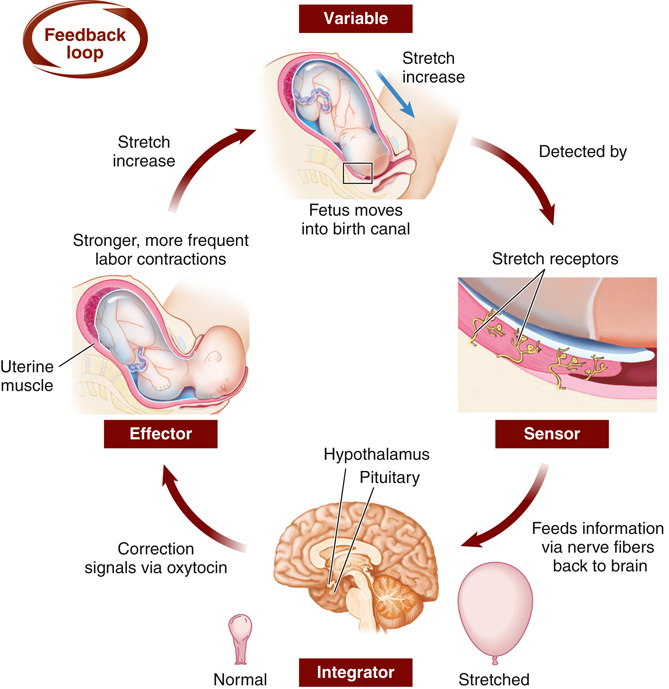
FIGURE 24.3 Positive feedback loop.An example of positive feedback occurs when a baby is born. As the baby is pushed from the womb (uterus) into the birth canal (vagina), stretch receptors detect the movement of the baby. Stretch information is fed back to the brain, triggering the pituitary gland to secrete a hormone called oxytocin (OT). OT travels through the bloodstream to the uterus, where it stimulates stronger contractions. Stronger contractions push the baby farther along the birth canal, thereby increasing stretch and stimulating the release of more OT. Uterine contractions quickly get stronger and stronger until the baby is pushed out of the body, and the positive feedback loop is broken. OT also can be injected therapeutically by a physician to stimulate labor contractions. From Patton KT, Thibodeau GA: The human body in health and disease, ed 7, St. Louis, 2018, Elsevier.
• Calcitonin: Regulates calcium and phosphate levels in the blood. It works against the parathyroid hormone action. Calcitonin helps lower blood calcium levels by inhibiting osteoclast activity. By inhibiting the breakdown of bone, it helps to retain calcium in the bones. Calcitonin also works in the kidney by reducing the resorption of calcium, thus also lowering the blood calcium level.
When thyroid hormone levels decrease in the body, the hypothalamus secretes TSH-releasing hormone. This hormone “tells” the anterior lobe of the pituitary gland to produce TSH, which stimulates the thyroid to produce hormones. Iodine from our diet is absorbed in the blood and carried to the thyroid gland. Iodine is required to produce T3 and T4.
Increasing the Basal Metabolic Rate
T3 and T4 hormones increase the basal metabolic rate, which has the following functions:
• Causes an increase in the body temperature and pulse rate; it also creates a stronger heartbeat.
• Helps the brain mature in children and promotes growth.
• Improves concentration and faster reflexes.
• Uses more energy (calories).
Parathyroid Glands
Learning Objective: Describe the parathyroid glands and the action of the hormone they secrete.
The parathyroid glands are four pea-sized glands located on the back side of the thyroid gland. They secrete parathyroid hormone (PTH), which helps regulate calcium and phosphorus levels in the body. When the blood calcium level decreases, PTH is secreted, causing calcium to be released from bone. The released calcium is absorbed in the blood, which increases the blood calcium levels.
A balance needs to be maintained. If too much PTH is secreted, hyperparathyroidism occurs, causing bones to lose calcium and the blood calcium level to rise. If too little PTH is secreted, hypoparathyroidism occurs. The blood calcium level decreases, and the blood phosphorus level increases.