
Closing Comments
April 11, 2024
Closing Comments
Patient Coaching
Patients with vision or hearing impairment face serious challenges. For these patients, the medical assistant must use good listening skills, appropriate nonverbal methods, and touch to communicate empathy and understanding. Teaching may have to be adapted to meet the special needs of these patients. A person with a vision loss benefits from large-print forms and handouts, increased lighting, and verbal rather than written instructions to reinforce learning. For an individual with a hearing deficit, printed instructions, demonstrations of how to manage treatments, or even sign language interpretation should be available to ensure accurate communication. Including family members in the patient’s treatment plan and offering referrals to appropriate community or professional resources may be very beneficial to a patient with sensory loss. Each patient must be assessed individually to determine the type of adaptation needed.
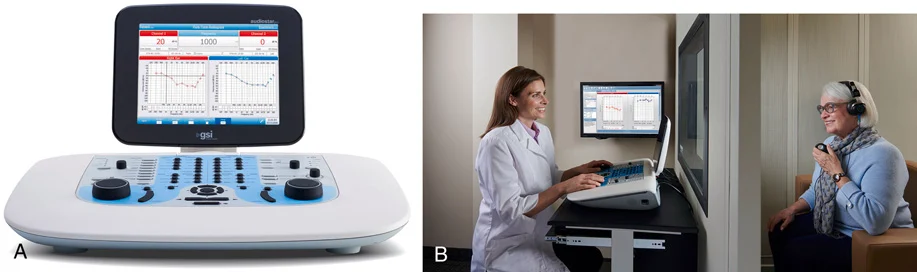
FIGURE 16.19 (A) Audiometer. (B) The patient signals when he hears a sound. Courtesy GSI Grason-Stadler.
An important part of patient coaching for those administering eye medications at home is stressing the need to maintain the sterility of the medication. Patients and family members must be taught how to apply the medication while preventing trauma to the eye and contamination of the applicator. Patients administering ear treatments also must understand how to instill the medication.
Legal and Ethical Issues
The Americans with Disabilities Act (ADA) was passed in 1990, and amendments were added in 2008. The Americans with Disabilities Act Amendments (ADAA) prohibit discrimination based on disability. An individual with a disability is defined by the ADAA as a person who has a physical or mental impairment that substantially limits one or more major life activities, a person who has a history or record of such an impairment, or a person who is perceived by others as having such an impairment. Public facilities, including ambulatory care facilities and other healthcare buildings, must comply with ADAA requirements for physical accommodations. Public medical facilities must provide individuals with disabilities access to communication devices if they have a problem with vision, hearing, reading, or comprehension. Additional details can be found at www.ada.gov/nprm_adaaa/adaaa-nprm-qa.htm.
Patient-Centered Care
Diminished sight or hearing may render a patient seriously impaired. To prevent accidents and office injuries, always ask sight- or hearing-impaired patients whether they require assistance. When you escort the patient to an examination room, offer your arm and tell the patient the approximate distance you will be walking. If the patient is to have an examination that involves local anesthesia or eye drops that dilate the pupil, be sure the patient has recovered, has sunglasses, and that someone is available to drive the patient home before allowing them to leave the facility. Never assume that the patient is capable of leaving alone. If the patient insists on leaving before the designated recovery time, inform the provider and record the time and circumstances surrounding the event in the patient’s health record.
Professional Behaviors
Patients with vision and hearing problems require an extra level of professional courtesy and respectfulness. Imagine what it would be like if you could not see clearly or if you had difficulty understanding what your provider was saying to you. How would you like a family member who has sensory difficulties to be treated when visiting the provider? Focus on how you can adapt the facility’s environment to accommodate the needs of these patients. Is there adequate lighting? Are patient education materials available that have been adapted for individuals with vision impairment? How can you most effectively and respectfully communicate with a patient who has hearing loss? Many times, just the act of empathy—imagining yourself in the place of the patient—can help you treat patients with the respect and courtesy they deserve.