
Immunohematology
April 11, 2024
Learning Objective: Examine immunohematology.
Formerly called the blood bank, the immunohematology department of the laboratory is responsible for blood typing and cross-matching blood units for transfusion. The major reason for performing immunohematology tests is to prevent problems caused by incompatible blood types during blood transfusions. Compatibility testing (also called cross-matching) is performed to prevent transfusion reactions in patients receiving blood from a donor. Identifying potential Rh incompatibility problems in expectant mothers is another procedure done in immunohematology. Rh incompatibility between an expectant mother and the unborn child may result in hemolytic disease of the newborn (HDN), also known as erythroblastosis fetalis. (See Chapter 28 for more details on HDN.)
Blood Typing
Learning Objective: Describe the different blood types and how they impact blood transfusions.
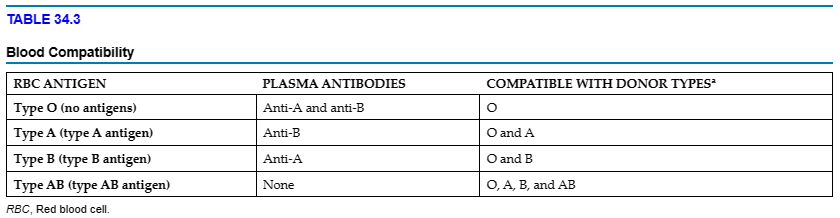
There are many blood antigen blood types. The two major blood antigen systems are the ABO system and the Rh system (see Chapter 25 for details). The ABO system has four major blood groups: A, B, O, and AB. Patients with type AB blood are considered universal recipients. Patients with type O blood are considered universal donors. TABLE 34.3 presents blood transfusion compatibility types.
Another major blood group is the Rh group. A person is either Rh positive (Rh+) or Rh negative (Rh−). Determinations of ABO and Rh blood groups are simple tests that can be performed easily. But because the consequences of performing the test incorrectly can be life threatening, blood typing is not a CLIA-waived test.
Blood Type Populations
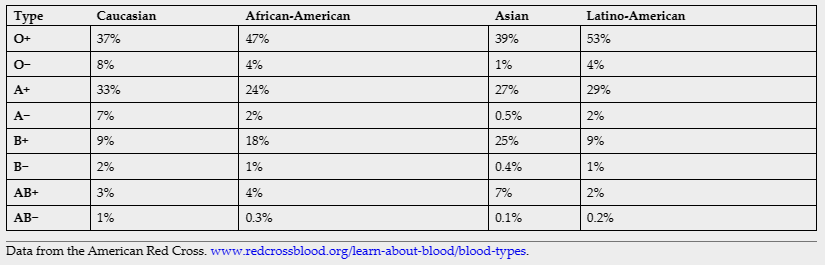
This table gives you an idea of the blood type frequency in a few different populations in the United States.
34.5 Critical Thinking Application
Griffin Jones is in for a physical today, but she would also like to have her blood type tested. She and her husband are thinking of starting a family soon and would like to know her ABO/Rh type. She thinks she is A−. If Griffin is A−, what antigen or antigens are on her RBCs?
Other Blood Types
In addition to the A and B antigens that characterize the ABO blood grouping, more than 600 antigens and more than 20 other blood antigen systems are known. Many are named after the person or family in which the blood antigen system was discovered. A medical assistant should be aware that other blood antigens exist. They may cause incompatibility issues in rare cases.
Legal and Ethical Issues Related to Blood Transfusion
Learning Objective: Describe the legal and ethical issues related to blood transfusions.
The Blood Safety Act was passed in 1991 to ensure that all donor blood is tested for human immunodeficiency virus (HIV) and other blood-borne pathogens. The impact of this law can be seen in the ambulatory care environment. The law requires providers to explain to each elective surgery patient the chances that they may need a blood transfusion. The discussion must include positive and negative aspects of autologous transfusion (i.e., transfusion with a person’s own blood). The pros and cons of transfusions from family, friends, or other donors should also be discussed. The conversation must be documented in the patient’s health record. Before the surgery, the patient must sign a form giving consent to any needed blood transfusions. The medical assistant should be aware that certain populations (e.g., Jehovah’s Witnesses) do not believe in blood transfusions.
If the patient decides to use autologous transfusions, this may require the patient to donate blood several weeks before the procedure. Usually, autologous transfusions are performed for stable patients undergoing major orthopedic, vascular, cardiac, or thoracic surgery. The medical assistant might need to help make arrangements for the blood donation. Another type of autologous transfusion can occur if the surgeon inserts an autologous drain in the surgical wound. The drain collects the blood from the surgical wound to prevent postoperative hematomas. The collected blood is then washed and reinfused into the patient.