Lesson 1, Topic 1
In Progress

Introduction
April 11, 2024

Introduction

Neurology is the healthcare specialty that deals with the diseases and disorders of the nervous system. A neurologist is a specialist involved in the diagnosis, treatment, and prevention of nervous system diseases and disorders. A neurosurgeon is a surgeon who operates on the nervous system as treatment for a neurologic disorder.
Besides the neurology department, patients with nervous system concerns can be seen in primary and urgent care departments. The medical assistant may help the provider with the examination and screening questions.

Nervous System Structures

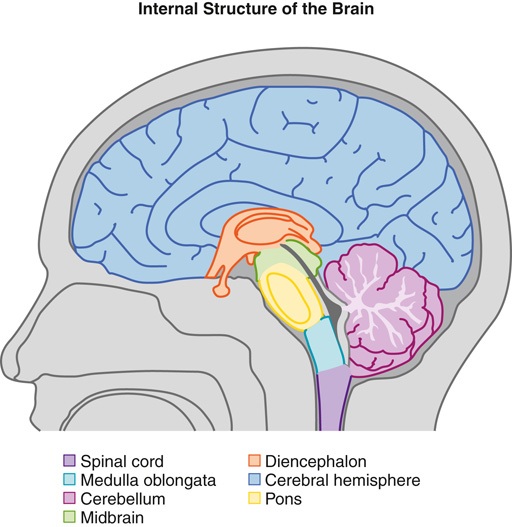
The main structures of the nervous system include the brain, spinal cord, and nerves. Various other sense organs, besides the nerves, exist throughout the body, such as the eyes. The nervous system is made up of nerve cells, or neurons. (Neurons are discussed in the Physiology of the Nervous System section.)
The nervous system is divided as follows:

• Central nervous system (CNS), which is composed of the brain and the spinal cord.
• Peripheral nervous system (PNS), which is made up of all the nervous tissue outside of the CNS, including the 12 pairs of cranial nerves and 31 pairs of spinal nerves. The PNS can be further divided:

• Somatic nervous system, which is voluntary. It collects information and returns instructions to the skin, voluntary muscles, and joints.
• Autonomic nervous system (ANS), which is involuntary. It collects information and returns instructions to involuntary structures (e.g., involuntary muscles, glands, organs).

FIGURE 22.1  The structures of the brain.