Lesson 1, Topic 1
In Progress

Life Span Changes
April 11, 2024

Life Span Changes

Learning Objective: Analyze the life span changes that occur in the musculoskeletal system.

Over the life span, changes occur in both the skeletal and muscular systems. The following sections discuss the changes that occur.

Skeletal System Changes

Learning Objective: Analyze the life span changes that occur in the musculoskeletal system.

When the skeleton is developing prior to birth, cartilage and fibrous structures are present. Over time, these structures are replaced with bone matrix, and the bones change size due to the continual remodeling process of the bone cells.
During childhood, bones grow rapidly. The prime time to build bone mass or density is from childhood to young adulthood. Bone density can increase through a calcium-rich diet and regular weight-bearing exercise. Poor nutrition, inactivity, smoking, and excessive alcohol intake can reduce bone density.
The following are common skeletal system changes that occur with age:

• Bones lose calcium and other minerals, which reduces bone mass or density. Bone density starts to decrease around age 30 to 40 in both males and females. It accelerates in women after menopause. The loss of bone density makes the bones more brittle, leading to osteoporosis and fractures.

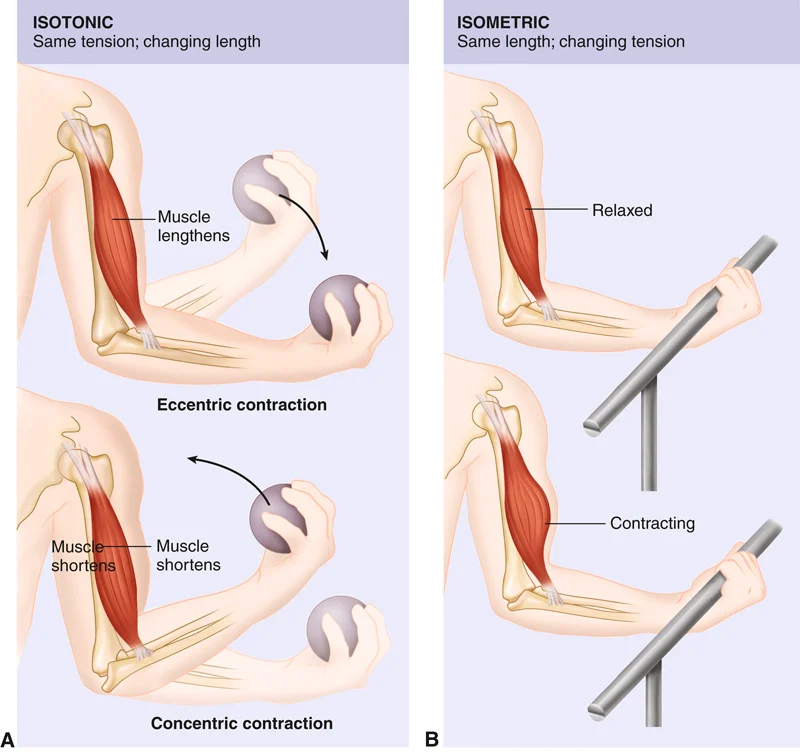
FIGURE 20.8  Types of muscle contraction. (A) In isotonic contraction, the muscle changes length, producing movement by either eccentric contraction (muscle lengthens) or concentric contraction (muscle shortens). (B) In isometric contraction, the muscle pulls forcefully against a load but does not shorten. From Patton KT, Thibodeau GA: The human body in health and disease, ed 7, St. Louis, 2018, Elsevier.

• The disks between the vertebrae wear and tear with age. They can dehydrate, and the cartilage can stiffen, causing the disk to bulge.
• Loss of height from the compression and curving of the spinal column occurs, which can cause a more stooped posture.
• Joints become stiffer and less flexible. Synovial fluid decreases, and cartilage may wear away, causing degenerative changes. This can lead to inflammation, stiffness, pain, and deformities.

Muscular System Changes

Learning Objective: Describe the muscular system changes over the life span.

Men can see muscle changes in their 20s, whereas women are usually in their 40s when changes become obvious. With age, muscle tissue is replaced more slowly and may be replaced with tough, fibrous tissue. This makes the extremities look thin and bony. Muscles have less of an ability to contract. Lean body mass decreases. With the muscle mass changes, older people experience a loss of strength and endurance. They can experience fatigue and reduced activity tolerance. Fasciculations are more common with age. People who are unable to move an extremity may get muscle contractures.