Lesson 1, Topic 1
In Progress

Peripheral Nervous System
April 11, 2024

Peripheral Nervous System

Learning Objective: Differentiate among the structures of the peripheral nervous system.

The peripheral nervous system is made up of the nerves that exit the brain or spinal cord. Cranial and spinal nerves are part of the peripheral nervous system.

Cranial Nerves

Learning Objective: Describe the cranial nerves.

The peripheral nerves exiting the brain directly through the skull are called cranial nerves. Cranial nerves originate from the underside of the brain and relay information to and from the sensory organs and muscles of the face and neck (TABLE 22.1). Cranial nerves have a motor function, sensory function, or both.

Spinal Nerves

Learning Objective: Describe the spinal nerves.

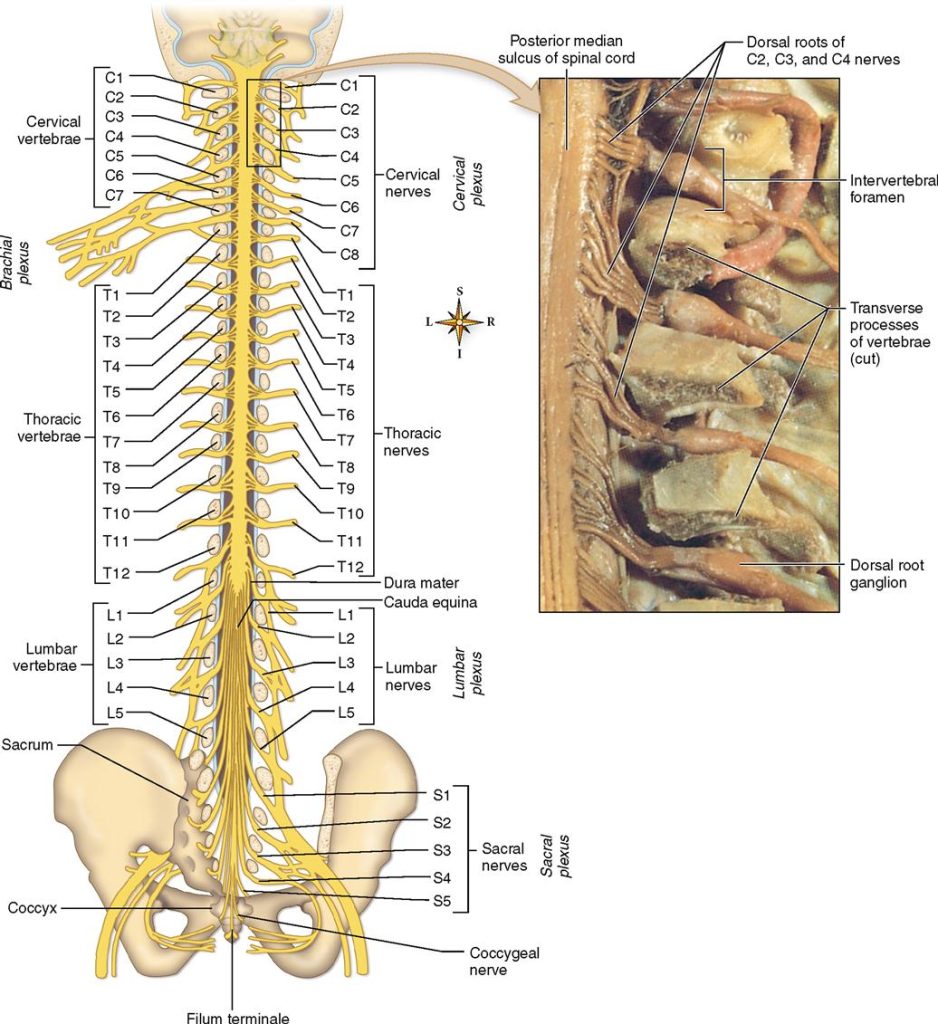
The spinal nerves exit the spinal canal through spaces between the vertebrae. Spinal nerves closely mimic the organization of the vertebrae and provide stimulation to the rest of the body. If the nerve fibers from several spinal nerves form a network, it is called a plexus. Spinal nerves are named by their vertebrae location (e.g., cervical, thoracic) and by number. Spinal nerves carry information to and from the brain through the spinal cord.
Dermatomes are skin surface areas supplied by a single afferent spinal nerve. These areas are so specific that the body can be mapped by dermatomes (FIGURE 22.5). Shingles, for example, appears on specific dermatomes based on which nerve the virus has infected.

22.2

Critical Thinking Application

Using the mnemonic “On Old Olympus Towering Top A Fine Vocal German Viewed Some Hops,” lists the cranial nerves in order.

FIGURE 22.3  The spinal cord, showing the spinal nerves. From Vidic B, Suarez FR: Photographic atlas of the human body, St. Louis, 1984, Mosby.